Schedule Controls
Last updated: 2026-08-24
Schedule controls are game-level information known before tipoff. They are not player traits and they are not lineup-composition features.
Back-to-Back Contract
The initial control is calculated from the complete competitive canonical game catalog, including games that are unavailable for modeling. Preseason, All-Star, cancelled, and postponed entries are excluded. For a team-game, define
Every stint and possession in game \(g\) receives the signed home-court value
The schedule mart is keyed by game_id and records home_back_to_back,
away_back_to_back, and home_minus_away_back_to_back. A game on the same
calendar day is not classified as a back-to-back.
Modeling Boundary
For source season \(t\), a possession-weighted Ridge model estimates the effect of \(x_g^{\mathrm{B2B}}\) after the season's player update. That completed coefficient is used in season \(t+1\) to remove known schedule pressure before the player RAPM fit, and is added back for frozen evaluation. The target season's game dates are permitted because the schedule is known before its outcomes; its target outcomes are never used to fit the control.
Short-Rest Travel Candidate
The next candidate is not yet part of production NAIL. It is built from the Team-Game Travel Mart: for each side, capped great-circle miles from the preceding competitive-game venue are retained only when the two scheduled UTC tipoffs are no more than 48 hours apart. The candidate contrast is
It was screened against frozen production residuals with HCA and B2B already included. The result does not justify a recursive refit:
| Frozen target | Standardized residual weight | Weighted correlation |
|---|---|---|
| 2023-24 | +0.061 | +0.001 |
| 2024-25 | -0.534 | -0.005 |
| 2025-26 | +0.139 | +0.001 |
| Pooled | -0.108 | -0.001 |
The signs are inconsistent and the correlations are effectively zero. The screen therefore rejects this one-coordinate candidate before expensive recursive fitting. The result does not establish that travel never matters; it only says that raw great-circle miles gated at 48 scheduled-tipoff hours add no stable residual signal beyond the current HCA and B2B controls.
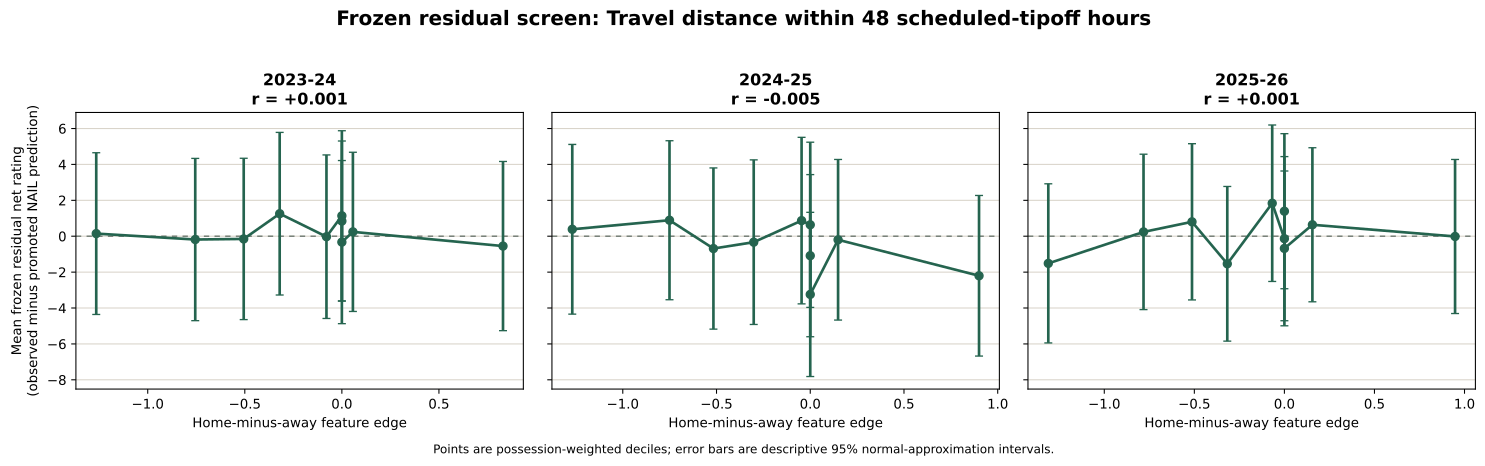
Artifact: artifacts/models/analysis/short_rest_travel_screen/short-rest-travel-screen-20260831T011021Z-dcc3123d.
Matchup Lab Scenarios
The Matchup Lab has no game date, so schedule conditions are optional scenario overlays rather than inputs to its core player or lineup edge. The user may choose a court state and independently mark either unit as being on a back-to-back. The displayed score is
where \(c\in\{-1,0,1\}\) encodes opponent home, neutral court, or your-unit home. The Lab uses possession-weighted completed-history reference values for \(h\) and \(b\), rather than a volatile selected-season coefficient. In the current v1.2.1.2 artifact those values are approximately \(+2.84\) points per 100 for home court and \(-1.52\) for a team on a B2B versus a rested opponent.
These scenario terms are displayed as separate ledger rows. They do not alter player ratings, additive profiles, non-additive lineup edge, or the underlying neutral-court GESTALT score. Realized-schedule evaluation and future game prediction continue to use the actual source-season B2B coefficient appropriate to their recursive training state.