NAIL Quartile Critical Spacing Plus Standard USG%
Status: experimental, not promoted. This candidate jointly changes the Critical Spacing threshold and its usage coordinate relative to the production NAIL-RAPM v1.2.1.
Contract
For each source-season player-profile pool \(P_t\), let \(q_t\) be the lower quartile of shrunk three-point makes per 100 possessions:
For five-man unit \(U\), Critical Spacing is the non-additive threshold event
Thus, the feature activates when at least two players are below the prior-season lower-quartile shooting threshold. It does not credit or penalize one low-threat player by itself. Across the frozen 2023-24 through 2025-26 regular-season samples, it activated for 26.0% of lineup sides on average (22.9%, 24.5%, and 30.6% by season).
The candidate also replaces the internal usage-events rate with conventional box-score usage percentage:
It then retains the same two non-additive terms as v1.2.1:
usage_concentration and top_two_assists. All player profiles, threshold
values, and context coefficients obey the forward information boundary.
Frozen Three-Season Results
The recursive model was fit from 1996-97 through 2025-26. The strict replay predicts 2023-24, 2024-25, and 2025-26 using only the relevant preseason player-prior state and the immediately preceding completed context state.
| Model | Poss. RMSE | Eligible game RMSE | Full-game RMSE | Winner accuracy | Team NetRtg RMSE | Pythagorean-win RMSE | Playoff eligible-game RMSE |
|---|---|---|---|---|---|---|---|
| NAIL-RAPM v1.2.1 | 1.197952 | 14.024550 | 14.252137 | 68.24% | 3.270613 | 7.035098 | 16.594200 |
| Quartile Critical Spacing + standard USG% | 1.197954 | 14.030448 | 14.258396 | 68.10% | 3.278702 | 7.045978 | 16.614526 |
The new candidate is effectively tied at the possession level, but it is worse
on every primary pooled game-level metric. Its full-game RMSE increases by
0.0063, winner accuracy falls by 0.14 percentage points, and playoff
eligible-game RMSE increases by 0.0203. It modestly improves possession MAE
and Pythagorean-win rank correlation, but neither offsets the losses in the
primary scorecard.
Coefficient Diagnostics
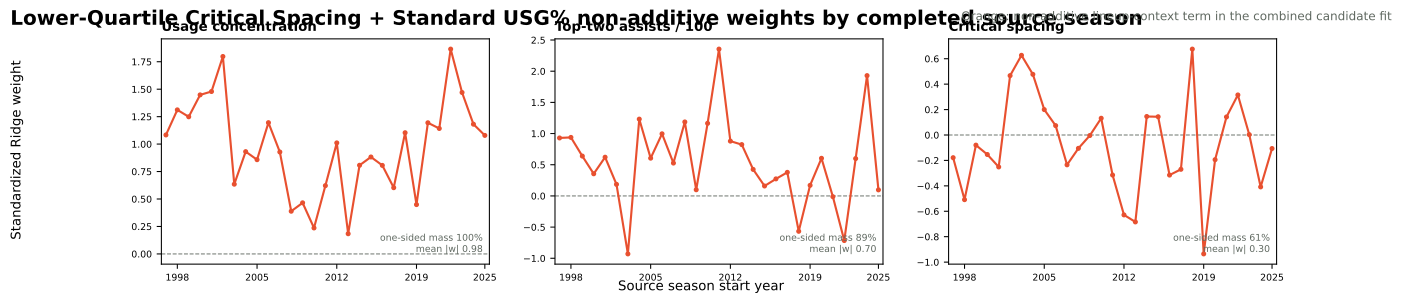
The chart shows the full non-additive contract, so the new term can be evaluated together with possible displacement of the two retained terms.
| Feature | Median standardized weight | Dominant directional mass | Interpretation |
|---|---|---|---|
| Usage concentration | +1.01 | 100.0% positive | Stable retained signal |
| Top-two assists | +0.60 | 89.1% positive | Stable retained signal |
| Critical Spacing | -0.10 | 61.2% negative | Expected sign, but weak and inconsistent |
The quartile threshold is more targeted than the previous lower-tercile candidate, but its coefficient is too unstable and it does not improve the frozen scorecard. The standard-USG% coordinate also does not recover an edge.
Decision
Do not promote this candidate. NAIL-RAPM v1.2.1 remains the production model. This result narrows the spacing hypothesis: a two-or-more low-threat event is directionally plausible, but this particular lower-quartile and standard-USG% formulation does not provide sufficient incremental predictive value.
Artifacts
- Recursive candidate:
artifacts/models/forward_nail_rapm_critical_spacing_quartile_standard_usage/2025-26/forward-nail-critical-spacing-quartile-standard-usage-2025-26-20260824T052154Z-9e32f2d8 - Frozen replay:
artifacts/models/nail_critical_spacing_quartile_standard_usage_frozen_backtest/frozen_multiseason_backtest/2023-24_to_2025-26/frozen_multiseason_backtest-2023-24-to-2025-26-20260824T053055Z-d8a33cc7 - Coefficient audit:
artifacts/models/analysis/nail_critical_spacing_quartile_standard_usage_weight_audit/nail-critical-spacing-quartile-standard-usage-weight-audit-20260824T053116Z-1d5bbe2c
Reproduction
See Train NAIL Quartile Critical Spacing Plus Standard USG%.