NAIL-RAPM v1.3: Expanded Additive Profiles
NAIL-RAPM v1.3 tests four additional additive player-profile features while holding the v1.2 prior, cold-start, gap-returner, and five non-additive lineup terms fixed. It is a documented, non-promoted experiment; production remains NAIL-RAPM v1.2.
Feature Contract
The candidate retains v1.2's eight additive profile components and adds:
| Feature | Source | Shrinkage contract |
|---|---|---|
| Defensive rebound percentage | Historical player-season panel | Existing stat-specific padding |
| Free-throw attempts per 100 possessions | Historical player-season panel | Existing published FTA padding |
| Unassisted rim makes per 100 | Assisted shot profiles | 480 pseudo-possessions toward the qualified-player median |
| Unassisted three-point makes per 100 | Assisted shot profiles | 480 pseudo-possessions toward the possession-weighted mean |
The unassisted-shot centers and 480-possession padding constants were selected strictly through 2022-23 by predicting each qualifying player's next-season rate. The frozen 2023-24 through 2025-26 target seasons do not influence that selection.
Additive Weight Audit
The contextual Ridge model standardizes every home-minus-away five-man feature before fitting. A coefficient below is therefore the change in predicted net rating per 100 possessions for a one-standard-deviation change in that lineup differential, conditional on the other profile and non-additive terms. It is a conditional model weight, not a causal player value or a standalone stat ranking.
Each column below is a separate completed source model. For example, the 2022-23 column was used to forecast frozen 2023-24 outcomes; no target-season outcomes enter these weights. This panel is the relevant view for the frozen evaluation.
| Additive feature | 2022-23 source -> 2023-24 target | 2023-24 source -> 2024-25 target | 2024-25 source -> 2025-26 target |
|---|---|---|---|
| Assists / 100 | +2.447 | +2.459 | +2.323 |
| Three-point makes / 100 | +1.103 | +1.975 | +2.223 |
| Steals / 100 | +1.225 | +2.795 | +1.724 |
| Offensive-rebound claim total | +0.276 | +0.764 | +1.552 |
| Turnovers / 100 | -1.782 | -1.040 | -1.512 |
| Free-throw attempts / 100 | +2.367 | +1.455 | +1.312 |
| Blocks / 100 | +0.642 | +0.567 | +0.734 |
| Unassisted rim makes / 100 | +0.460 | +1.908 | +0.678 |
| Usage / 100 | +0.145 | -0.961 | -0.342 |
| Three-point attempts / 100 | +0.492 | +1.121 | -0.280 |
| Defensive rebound percentage | -0.268 | +0.403 | +0.262 |
| Unassisted three makes / 100 | +0.590 | +1.041 | +0.246 |
The four bolded rows are v1.3 additions. FTA rate is consistently strong and positive. Unassisted rim makes are positive in all three source fits but vary in magnitude. Defensive rebound percentage changes sign, while unassisted three-point makes stay positive but have a smaller and declining weight. These patterns motivate ablation work before any future profile release.
Full Historical Trajectories
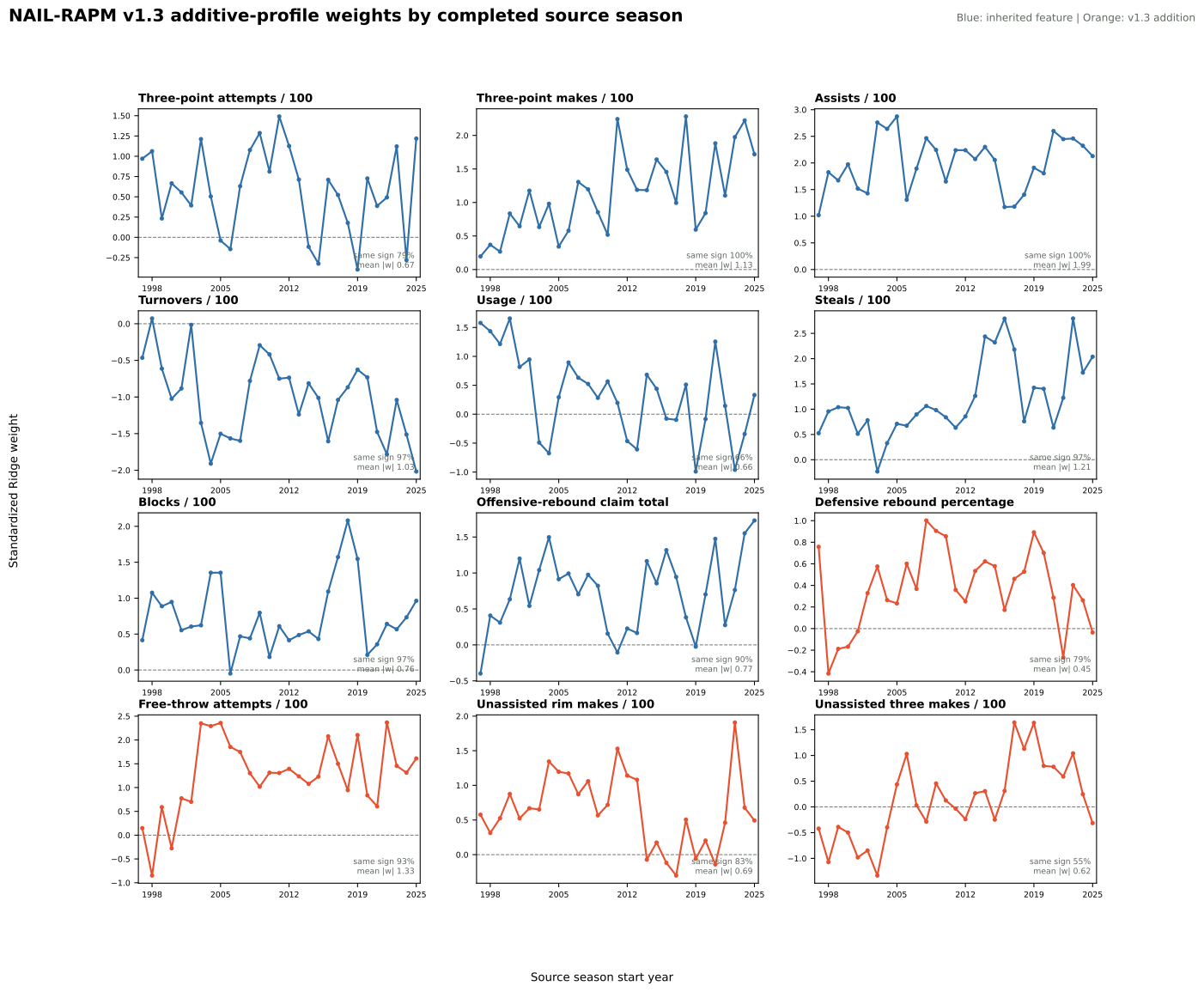
The same extraction is available for all 29 persisted source models, from 1997-98 through 2025-26. Green traces are inherited terms; orange traces are v1.3 additions. The annotation in each panel reports the dominant-sign share and mean absolute standardized weight over the complete history.
| Feature | Dominant direction | Same-sign seasons | Mean absolute weight |
|---|---|---|---|
| Assists / 100 | Positive | 29 / 29 | 1.99 |
| Three-point makes / 100 | Positive | 29 / 29 | 1.13 |
| Steals / 100 | Positive | 28 / 29 | 1.21 |
| Turnovers / 100 | Negative | 28 / 29 | 1.03 |
| Blocks / 100 | Positive | 28 / 29 | 0.76 |
| Free-throw attempts / 100 | Positive | 27 / 29 | 1.33 |
| Offensive-rebound claim total | Positive | 26 / 29 | 0.77 |
| Unassisted rim makes / 100 | Positive | 24 / 29 | 0.69 |
| Three-point attempts / 100 | Positive | 23 / 29 | 0.67 |
| Defensive rebound percentage | Positive | 23 / 29 | 0.45 |
| Usage / 100 | Positive | 19 / 29 | 0.66 |
| Unassisted three makes / 100 | Positive | 16 / 29 | 0.62 |
This makes the v1.3 diagnosis sharper. FTA rate is a credible persistent addition; unassisted rim finishing is promising but less stable; defensive rebound percentage is modest; and unassisted three-point make volume is too sign-unstable to justify retaining without a more focused experiment.
Frozen Results
Both models replay the same persisted recursive state into 2023-24, 2024-25, and 2025-26 with no target-season refit. v1.3 is effectively tied on pooled regular-season possession error, improves pooled playoff error slightly, but has worse regular full-game RMSE.
| Model | Regular poss. RMSE | Regular full-game RMSE | Winner accuracy | Team NetRtg RMSE | Pythagorean-win RMSE | Playoff poss. RMSE | Playoff eligible-game RMSE |
|---|---|---|---|---|---|---|---|
| NAIL-RAPM v1.2 | 1.197958 | 14.265989 | 68.16% | 3.2908 | 7.0899 | 1.192734 | 16.6148 |
| NAIL-RAPM v1.3 | 1.197987 | 14.298111 | 68.44% | 3.3320 | 7.0619 | 1.192630 | 16.5034 |
Non-Promotion Gate
The primary metric is full-game margin RMSE. The candidate is eligible only if the upper endpoint of the paired 95% game-block bootstrap interval for
is no greater than 0.5% of v1.2's RMSE in the pooled sample and in each frozen season. Positive values favor v1.2.
| Scope | v1.3 minus v1.2 | Paired 95% interval | Gate threshold | Gate |
|---|---|---|---|---|
| Pooled | +0.0321 | [-0.0114, +0.0740] | +0.0713 | Fail |
| 2023-24 | +0.0171 | [-0.0671, +0.1014] | +0.0697 | Fail |
| 2024-25 | +0.1026 | [+0.0182, +0.1876] | +0.0722 | Fail |
| 2025-26 | -0.0200 | [-0.0685, +0.0285] | +0.0720 | Pass |
The 2024-25 result demonstrates a material loss under the agreed rule. Therefore, v1.3 is not promoted despite its small pooled playoff and Pythagorean-win improvements.
Artifacts
- Candidate fit:
artifacts/models/forward_nail_rapm_v13_additive_profiles/2025-26/forward-nail-rapm-v13-additive-profiles-2025-26-20260821T230733Z-def6e560 - Frozen replay:
artifacts/models/nail_v13_additive_profiles_frozen_backtest/frozen_multiseason_backtest/2023-24_to_2025-26/frozen_multiseason_backtest-2023-24-to-2025-26-20260821T232409Z-81841f20 - Bootstrap gate:
artifacts/models/nail_v13_additive_profiles_bootstrap/2023-24_to_2025-26/nail-v13-additive-profiles-bootstrap-20260821T232731Z-c13f1209 - Weight audit:
artifacts/models/analysis/nail_v13_additive_weight_audit/nail-v13-additive-weight-audit-20260822T002651Z-74535a75
Reproduction commands are in Train NAIL-RAPM v1.3 additive profiles.