NAIL Critical-Spacing Candidate
Status: experimental. This is a controlled one-feature extension of NAIL-RAPM v1.2.1, not a released model.
Hypothesis
A lineup can contain a large aggregate shooting total while still having
multiple players whom a defense can help off. critical_spacing tests the
discrete version of that idea: a unit may become materially harder to space
once it has at least two low-threat shooters. This is structurally different
from summing player shooting rates, which is additive and already belongs in
the player-attributable profile layer.
For season-state profile pool \(P_t\), define its lower-tercile shrunk shooting cutoff as
For a unit \(U\), the feature is
The strict inequality prevents players exactly at the seasonal cutoff from
being classified as low threat. 3PM100 is the existing shrunk player-profile
rate, and both the profile and threshold come only from information available
before the target season. The lineup-context Ridge fit then estimates the
coefficient jointly with the eight additive profile totals, top_two_assists,
and usage_concentration.
Why This Differs From the Retired Shooter Count
The earlier credible_shooter_count supplied a broad linear count with a
fixed absolute cutoff. It was not directionally stable enough to retain in
v1.2.1. Critical Spacing instead tests one narrowly specified threshold event:
two or more players below an era-specific, shrunk shooting baseline. It may
still fail. The separation is intentional so the frozen comparison answers a
single, interpretable question.
Evaluation Plan
The candidate is fit recursively across the historical panel and evaluated on the frozen 2023-24, 2024-25, and 2025-26 regular seasons against v1.2.1. The same paired game-block bootstrap non-promotion gate applies: the upper 95% bound for full-game RMSE harm must not exceed 0.5% of the incumbent RMSE in the pooled result or any target season.
Frozen Results
The recursive fit completed through 2025-26 and the strict frozen replay forecast 2023-24 through 2025-26 using each target season's preseason information set. The candidate is evaluated directly against v1.2.1.
| Model | Poss. RMSE | Eligible game RMSE | Full-game RMSE | Winner accuracy | Team NetRtg RMSE | Pythagorean-win RMSE | Playoff eligible-game RMSE |
|---|---|---|---|---|---|---|---|
| NAIL-RAPM v1.2.1 | 1.197952 | 14.024550 | 14.252137 | 68.24% | 3.270613 | 7.035098 | 16.594200 |
| Critical Spacing candidate | 1.197954 | 14.024052 | 14.253192 | 68.47% | 3.280515 | 7.060052 | 16.589610 |
The candidate changes pooled full-game RMSE by +0.0011 (candidate minus
v1.2.1), effectively no aggregate movement. Its point estimates improve in
2023-24 and 2024-25 but worsen by +0.0176 in 2025-26. The pooled paired
10,000-draw game-block bootstrap interval is [-0.0059, +0.0080]; it passes
the predeclared no-material-harm threshold of +0.0713, but does not establish
a meaningful advantage.
| Scope | Full-game RMSE difference | Paired 95% interval | Gate |
|---|---|---|---|
| Pooled | +0.0011 | [-0.0059, +0.0080] | Pass |
| 2023-24 | -0.0078 | [-0.0168, +0.0014] | Pass |
| 2024-25 | -0.0083 | [-0.0157, -0.0008] | Pass |
| 2025-26 | +0.0176 | [+0.0003, +0.0348] | Pass |
Non-Additive Coefficient Audit
The chart reports the full three-term non-additive contract from the candidate fit: the two retained v1.2.1 terms plus Critical Spacing. This is required to inspect possible coefficient displacement rather than assessing the new term in isolation.
Across 29 completed source-season states, the standardized critical-spacing
coefficient is negative in 19 seasons and positive in 10. The agreed stability
measure is total one-sided mass, not binary sign count: the negative side
accounts for 9.38 coefficient-mass versus 2.36 on the positive side, or a
79.9% negative directional-mass share. Its median is -0.20, mean absolute
magnitude is 0.40, and range is -1.55 to +0.59. The chart shows a broadly
downward historical path, with the large-magnitude observations concentrated on
the expected negative side. The small positive crossings are real but do not
overturn the directional-mass evidence.
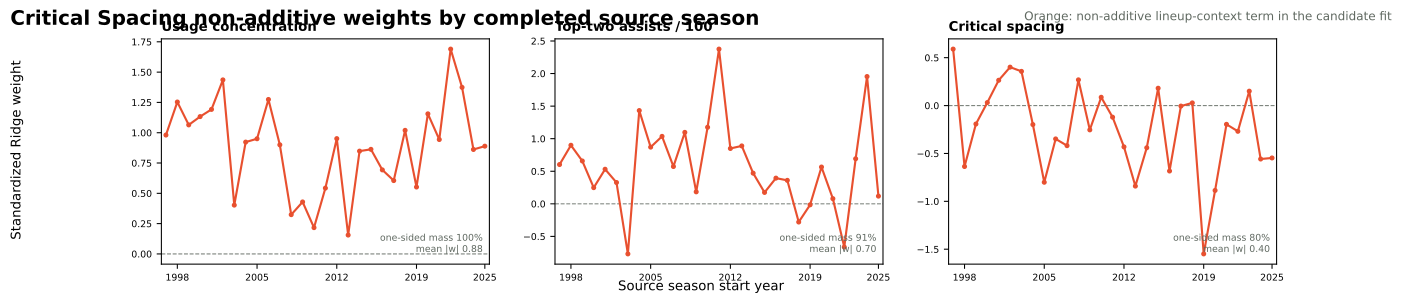
The candidate does not materially displace either incumbent term. Matched
source-season weights for usage_concentration have Pearson correlation
0.9885 with v1.2.1 and mean absolute change 0.0449 standardized units;
top_two_assists has correlation 0.9868 and mean absolute change 0.0850.
Critical Spacing therefore adds a mostly independent third non-additive signal
rather than substituting for either retained feature.
Decision
Do not yet promote the candidate. It clears the non-promotion gate and the
directional-mass audit supports a negative Critical Spacing effect. The reason
to hold the production model at v1.2.1 is narrower: there is no meaningful
pooled full-game improvement (+0.0011 RMSE). This candidate remains a
directionally credible feature rather than a rejected one.
Artifacts
- Recursive candidate:
artifacts/models/forward_nail_rapm_critical_spacing/2025-26/forward-nail-critical-spacing-2025-26-20260823T223333Z-f9430d81 - Frozen replay:
artifacts/models/nail_critical_spacing_frozen_backtest/frozen_multiseason_backtest/2023-24_to_2025-26/frozen_multiseason_backtest-2023-24-to-2025-26-20260823T224105Z-a201166a - Paired bootstrap:
artifacts/models/nail_critical_spacing_bootstrap/2023-24_to_2025-26/nail-critical-spacing-bootstrap-20260823T224136Z-c1b037d5 - Coefficient audit:
artifacts/models/analysis/nail_critical_spacing_weight_audit/