Constrained Split NAIL
Constrained Split NAIL is a descriptive offense/defense allocation of the published production NAIL-RAPM rating. It is not a replacement value model and does not appear on the frozen net-margin leaderboard.
Locked-total contract
For every player (i), production NAIL supplies a fixed total rating (R_i^{\mathrm{NAIL}}). Constrained Split NAIL estimates only the difference (s_i=O_i-D_i), then reconstructs:
Therefore the invariant is exact for every player:
The same constraint applies to the base player state, each of the eight additive-profile coefficients, both retained non-additive lineup terms, back-to-back, and home court. The total scalar NAIL model is never refit.
What is learned
Each observed stint becomes two possession-weighted scoring observations:
The constrained model learns the O-minus-D specialization coordinates against those two targets with total NAIL coefficients fixed. A team can therefore have an offensive rating, a defensive rating, and a locked total value. The resulting margin prediction remains production NAIL by construction; only the allocation between scoring and prevention changes.
Forward selection
The source-season constrained state is applied to the following season. Player
and context specialization precision are selected jointly from
0.1, 0.2, 0.5, 1, 2, 4, 8, 16, 32, and 64. Selection
minimizes possession-weighted out-of-sample scoring-side RMSE across 2019-20
through 2022-23:
This is intentionally a side-scoring criterion, not the regular frozen leaderboard. Once \(O_i+D_i\) is fixed, changing the split cannot improve net margin prediction.
The grid has a hard boundary rule: a minimum at 0.1 or 64 on either axis
is not accepted as a selected specification. The grid must be expanded and
replayed before publishing the O/D allocation. Higher precision means a
stronger Ridge pull of that block's O-minus-D differences toward zero; locked
scalar coefficients remain unchanged.
These are individual-stint scoring targets, not full-game ratings. Short stints produce noisy realized rates, so the absolute scale is much larger than the net-margin RMSE on the frozen leaderboard. Every candidate evaluates the identical 847,028 offensive possessions.
Selected allocation
The first full joint sweep evaluated all 100 pairs across the four development target seasons. It selected the interior point
with pooled scoring-side RMSE of 67.6699 and MAE of 51.0724. The next
closest RMSE cells were (0.5, 64) at 67.6699 and (0.5, 16) at 67.6703.
(0.5, 32) is retained because it is the grid minimum and neither coordinate
is an outer boundary.
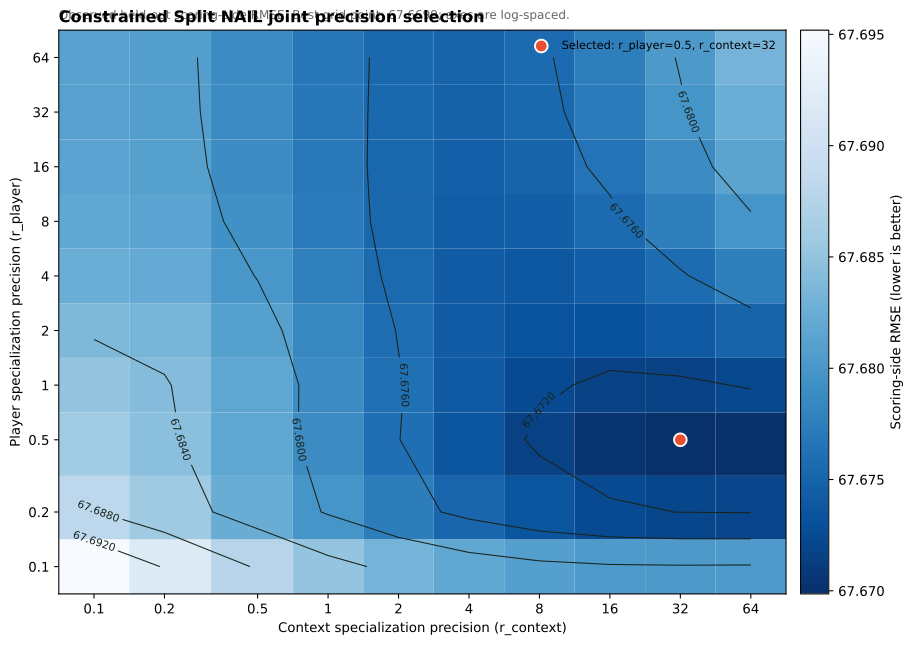
The colored cells are the 100 evaluated configurations. Contours summarize the same discrete result surface on log-spaced axes; they do not claim that untested intermediate precisions were fit. The red marker is the selected pair.
The completed 2025-26 allocation preserves the scalar production rating to machine precision: the maximum absolute value of \(O_i + D_i - R_i^{\mathrm{NAIL}}\) across 582 players is \(8.9 \times 10^{-16}\).
Additive profile allocation
Production NAIL already compiles its eight additive box-score profile features into each player rating. Constrained Split NAIL holds that total contribution fixed, but allocates it using the learned feature-side differences. The allocation is centered at the same possession-weighted reference-player coordinate used by published NAIL ratings, so it does not create a new league baseline or change total value.
Artifacts
Each run writes a self-contained artifact under
artifacts/models/constrained_split_nail/<season>/:
| Artifact | Contents |
|---|---|
player_ratings.parquet |
Locked total NAIL, O/D base, O/D additive profile, and exact sum check. |
feature_allocations.parquet |
Total and O/D coefficients for additive and non-additive terms. |
control_allocations.parquet |
Total and O/D allocations for B2B and home court. |
side_scoring_selection_by_season.parquet |
Per-season held-out scoring-side errors for every precision candidate. |
side_scoring_selection_summary.parquet |
Pooled precision-selection result. |
season_states.joblib |
Forward-complete specialization states. |
Web companion cache
The public app receives Constrained Split NAIL through a compact sidecar cache, not through a second prediction model. The cache is explicitly stamped with the production NAIL artifact and run ID. At load time, the API rejects it unless that identity matches the active scalar release and every covered player-season satisfies (O_i + D_i = R_i^{\mathrm{NAIL}}) to machine precision.
uv run nba-build-constrained-split-cache
This materializes the complete historical player-season O/D allocation under
artifacts/web/constrained_split_ratings/. Completed-season Rankings and
player histories can therefore show offense and defense alongside scalar NAIL;
the Matchup Lab can show offense vs. defense plus defense vs. offense.
For observed five-man tables, the same side allocation is also applied to the
retained non-additive lineup terms against the opponents each unit actually
faced. The published Off and Def columns therefore sum to the complete
scalar Edge, including the non-additive lineup edge. They do not alter the
GESTALT score or any prediction.
The preseason 2026-27 preview intentionally has no O/D allocation until a
completed Split NAIL companion state is fitted for that scalar release.
Reproducing the precision figure
uv run nba-audit-constrained-split-nail-precision \
  --run-dir artifacts/models/constrained_split_nail/2025-26/<run-id>
The renderer reads only side_scoring_selection_summary.parquet and the
selected coordinates in metadata.json; it does not refit any model state.