NAIL Lower-Quintile Critical-Spacing Candidate
Status: rejected experimental variant. This candidate uses the exact NAIL-RAPM v1.2.1 contract plus one Critical Spacing indicator. It changes only the cutoff from the lower tercile to the lower quintile.
Hypothesis
The lower-tercile test may have included too many merely below-average
shooters. This stricter candidate identifies only the bottom 20% of the
forward-safe, season-state shrunk three_pm_per_100 profile distribution. A
unit activates the term when at least two of its five players fall strictly
below that cutoff:
Every profile and threshold is constructed from information available before
the target season. The player prior, additive profile, retained
usage_concentration and top_two_assists terms, and Ridge regularization are
unchanged from v1.2.1.
Frozen Results
The recursive candidate was fit through 2025-26 and evaluated on the three strict frozen regular-season and playoff holdouts. The stricter cutoff does not improve the incumbent and is modestly worse on the primary aggregate metrics.
| Model | Poss. RMSE | Eligible game RMSE | Full-game RMSE | Winner accuracy | Team NetRtg RMSE | Pythagorean-win RMSE | Playoff eligible-game RMSE |
|---|---|---|---|---|---|---|---|
| NAIL-RAPM v1.2.1 | 1.197952 | 14.024550 | 14.252137 | 68.24% | 3.270613 | 7.035098 | 16.594200 |
| Lower-quintile Critical Spacing | 1.197960 | 14.041824 | 14.272532 | 68.10% | 3.298537 | 7.090747 | 16.627064 |
This was stopped before paired bootstrap because the point estimates are uniformly inferior to v1.2.1 on the primary regular-season and playoff aggregates. It is therefore not a promotion candidate.
Full Non-Additive Audit
The diagnostic includes all three non-additive terms, not only the test candidate. That makes it possible to distinguish a genuinely incremental term from one that merely displaces a retained coefficient.
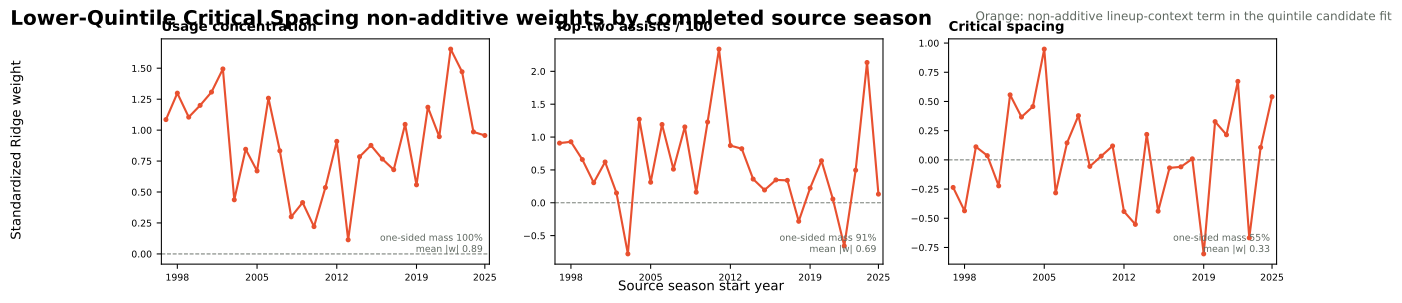
The new Critical Spacing coefficient is not directionally credible under the
agreed total one-sided-mass criterion. It has positive mass 5.24 and negative
mass 4.27, so only 55.1% lies on its dominant positive side, despite the
hypothesis expecting a negative spacing penalty. Its median standardized weight
is +0.04, mean absolute magnitude is 0.33, and range is -0.81 to +0.95.
The candidate also does not explain its failure through displacement of the
retained terms: matched source-season weights remain highly aligned with
v1.2.1. usage_concentration has Pearson correlation 0.9941 and mean
absolute change 0.0303; top_two_assists has correlation 0.9881 and mean
absolute change 0.0710. The lower-quintile term is simply too selective and
too unstable to add useful residual predictive signal.
Decision
Do not promote. The tercile candidate had a more coherent negative direction but no meaningful aggregate lift; the quintile candidate is both less stable and predictively worse. Future spacing work should test a richer, forward-safe non-additive formulation rather than additional hard quantile cutoffs.
Reproducibility
- Recursive fit:
artifacts/models/forward_nail_rapm_critical_spacing_quintile/2025-26/forward-nail-critical-spacing-quintile-2025-26-20260823T233944Z-ffce4c9e - Frozen replay:
artifacts/models/nail_critical_spacing_quintile_frozen_backtest/frozen_multiseason_backtest/2023-24_to_2025-26/frozen_multiseason_backtest-2023-24-to-2025-26-20260823T234533Z-9470b3b9 - Coefficient audit:
artifacts/models/analysis/nail_critical_spacing_quintile_weight_audit/nail-critical-spacing-quintile-weight-audit-20260823T234558Z-a241fd1b