Pooled Replacement-Token RAPM
This diagnostic estimates a replacement-player group effect directly in the RAPM design matrix. It corrects a failed first attempt that averaged the separately ridged coefficients of low-exposure players; those individual coefficients were mechanically shrunk toward zero and cannot estimate the group's impact.
Token Design
Within each completed regular season, identify cataloged player IDs with a
realized team-possession share below a cutoff. Replace every such individual
player token with one shared replacement token. For stint \(t\), its signed
feature is
where \(n\) is the number of low-exposure players in the lineup. All other players retain their ordinary signed RAPM token. The fitted equation is
Thus \(\beta_{replacement}\) is the per-player RAPM coefficient applied once for each replacement token in a lineup. It pools the group's possession exposure instead of regularizing hundreds of sparse individual columns independently toward zero.
The model reuses the canonical season-specific RAPM lambda. This isolates the tokenization change; it does not claim that the existing lambda is optimal for the lower-dimensional token design.
Historical Result
The primary immutable run is
artifacts/models/replacement_token/2025-26/replacement-token-2025-26-20260806T010704Z-4863a48f/.
It fits one full-season token model for each season from 1996-97 through
2025-26, using a 5% realized exposure cutoff.
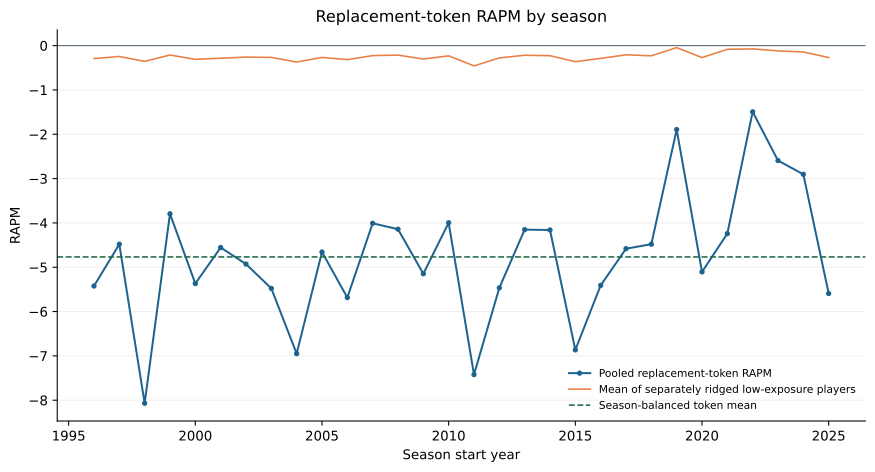
| Exposure cutoff | Season-balanced token RAPM | 90% season-block interval |
|---|---|---|
| 2% | -3.870 | [-4.306, -3.448] |
| 5% | -4.768 | [-5.180, -4.344] |
| 10% | -4.732 | [-4.979, -4.472] |
At the 5% cutoff, the mean of the original separately ridged player
coefficients was only -0.247. The pooled token therefore demonstrates the
expected shrinkage failure directly: low-exposure individual estimates are
not an estimate of low-exposure group quality.
The pooled estimate is more negative than the usual informal -2 replacement
benchmark. It is a valid consequence of this exact retrospective group and
this RAPM scale, but it should not yet be promoted as the project-wide
replacement level. The cutoff is based on realized same-season exposure, and
the low-minute pool can contain injury cases alongside two-way, 10-day, and
fringe-roster players.
What This Establishes
This is the correct measurement strategy for the proposed group: represent replacement candidates with a shared feature and let the lineup model estimate their pooled effect. It is not a preseason cold-start model because group membership uses future, realized exposure.
The next predictive slice is to learn a preseason-only gate that assigns a replacement token before the season, then evaluate that gate on a complete future-season holdout. Contract, transaction, and roster-status data would make the historical group definition more precise.
Artifacts
| File | Contents |
|---|---|
season_replacement_token_coefficients.parquet |
One shared-token coefficient per season, canonical lambda, group size, and comparison to separately ridged values |
replacement_token_summary.json |
Season-balanced estimate, bootstrap interval, cutoff, and retrospective status |
replacement-token-by-season.svg |
Published comparison of pooled and separately ridged estimates |
metadata.json / manifest.json |
Token, cutoff, source, code, and artifact-integrity contract |