Screen a Frozen Feature
Use this diagnostic before spending a full recursive training run on a proposed lineup-context feature. It asks a narrow question: after the promoted frozen NAIL-RAPM v1.2.1.3 prediction has accounted for player ratings, the retained non-additive terms, home court, and back-to-back status, does the candidate still align with the remaining stint-level residual?
Run
uv run nba-screen-frozen-feature median_three_pm_per_100
The first registered candidate is the home-minus-away difference in the median
of each unit's five prior-season, shrinkage-adjusted 3PM / 100 values. With
five players, that is the third-ranked shooting profile, so it tests whether a
unit has a credible third shooter rather than simply one elite shooter.
Contract
For target season t, the feature uses only player profiles available before
that season. The residual is:
y_s is the observed home net rating for stint s; the prediction is replayed
from the persisted state through t-1. No target-season player, context, or
schedule parameter is refit. Target outcomes are used only to evaluate the
screen.
For a feature already present in the production context model, the diagnostic uses a leave-one-term-out version of that same frozen prediction. It zeros only that feature's home-minus-away context input before scoring, while holding every other player, context, home-court, and back-to-back component fixed. That makes production features valid positive controls: their own contribution is left in the residual instead of being subtracted away by the full prediction.
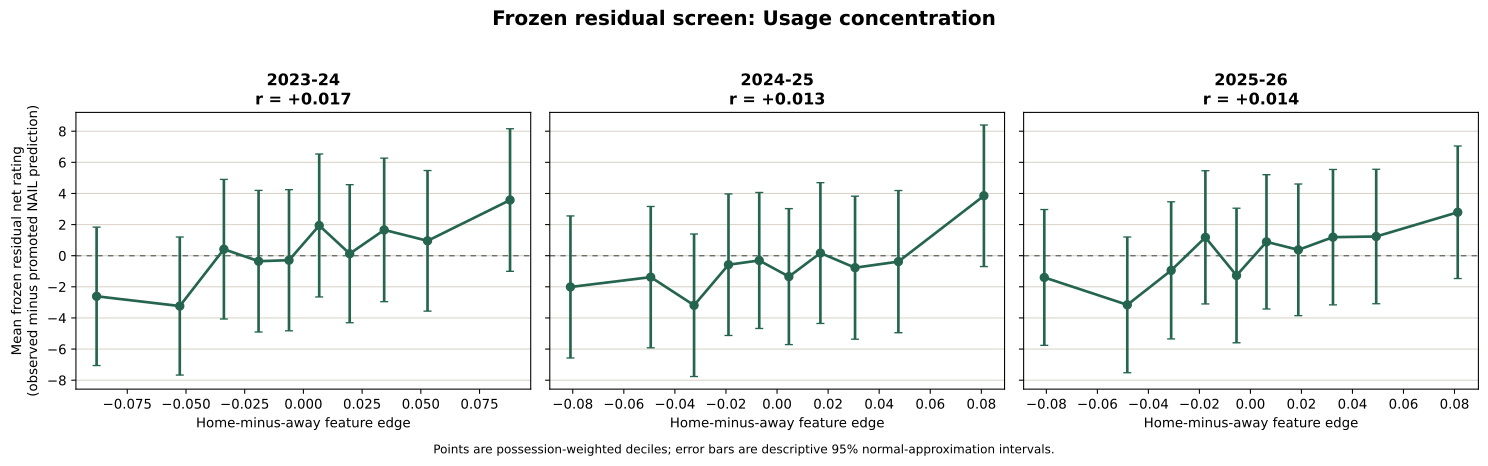
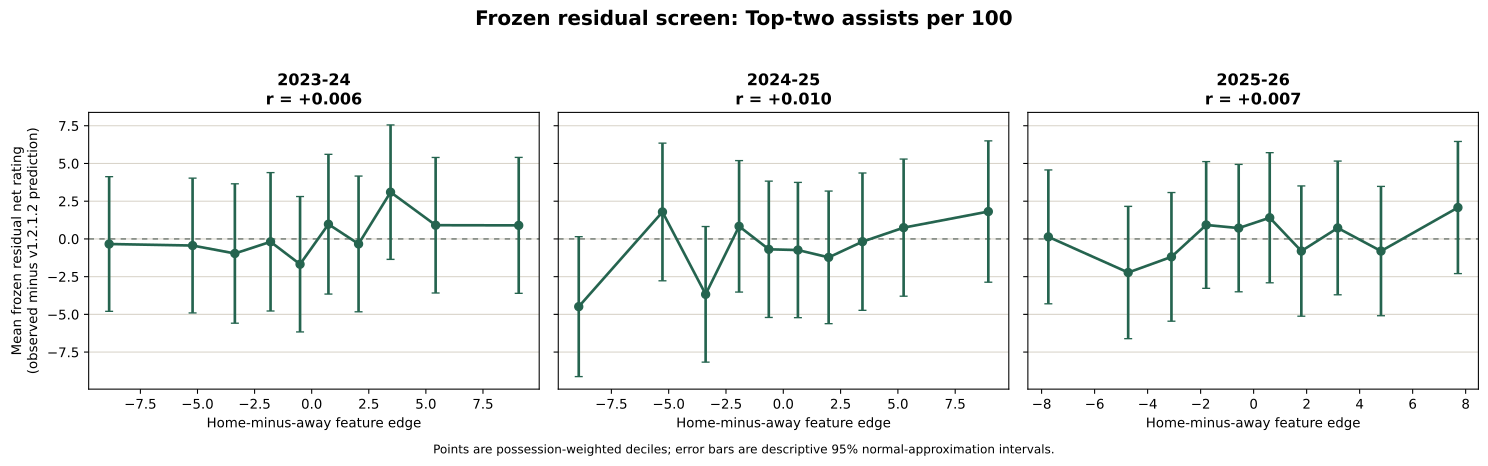
Continuous candidates are divided into ten deterministic rank deciles. Binary or otherwise low-cardinality candidates retain their natural value groups so a one-hot feature is not artificially split across deciles. Each point is a possession-weighted mean residual. The displayed 95% intervals are descriptive normal approximations using effective stint sample size, not game-clustered inference.
Outputs
Each run writes an immutable artifact directory under
artifacts/models/analysis/frozen_feature_screen/<feature>/<run-id>/:
| Artifact | Purpose |
|---|---|
stint_residuals.parquet |
Frozen prediction, observed rating, residual, and candidate values for every regular-season stint. |
residual_bins.parquet |
Per-season and pooled bin means, descriptive intervals, and weighted residual correlations. |
metadata.json |
Candidate definition, promoted source-model run, seasons, and information-boundary contract. |
The command also renders the chart to
docs/assets/images/frozen-feature-screens/<feature>-residual-screen.svg by
default. A candidate advances to a full recursive training experiment only if
this screen shows a stable, basketball-plausible conditional pattern across the
three frozen seasons.
Registering Candidates
Candidate definitions live in
src/nba_lineup_model/modeling/frozen_feature_screen.py as FeatureCandidate
entries. A new candidate provides a function mapping a five-player unit and its
frozen profile table to one scalar. The diagnostic forms the home-minus-away
contrast automatically, so every feature follows the same sign convention.
Initial Result: Median Lineup 3PM / 100
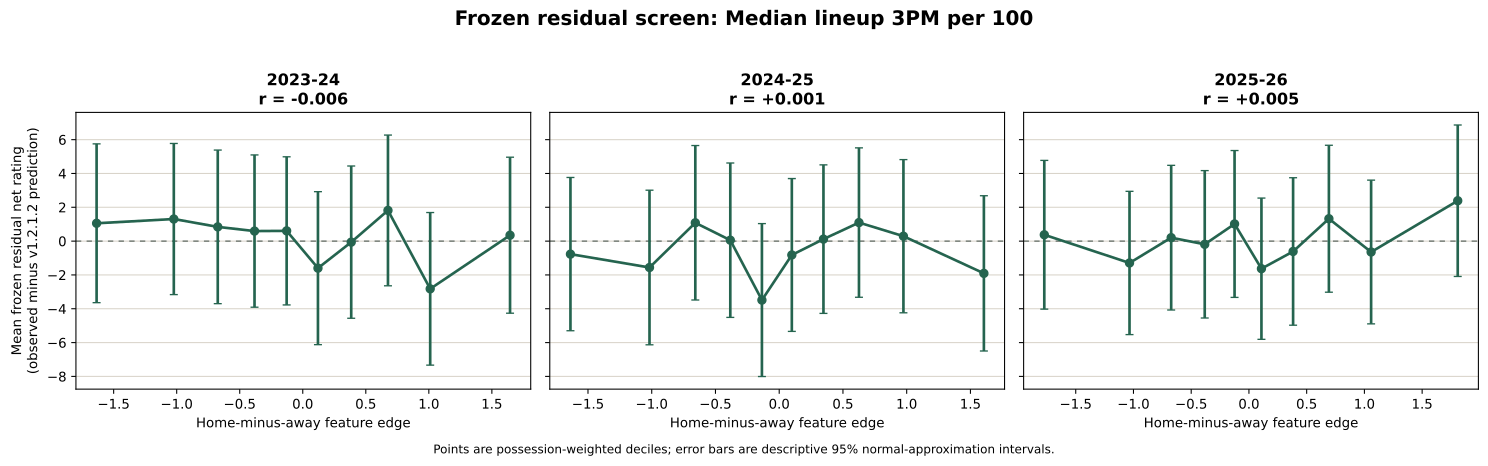
The initial screen used the promoted v1.2.1.2 state and all three frozen regular seasons. It covered 108,799 stints and 348,786 possessions. The possession-weighted correlation between the median-shooting edge and the frozen residual was effectively zero in every season:
| Target season | Weighted residual correlation |
|---|---|
| 2023-24 | -0.0058 |
| 2024-25 | +0.0011 |
| 2025-26 | +0.0045 |
| Pooled | +0.0003 |
The residual deciles have no monotonic or stable conditional pattern, so median lineup 3PM / 100 does not advance to a recursive model experiment.
Candidate Result: Rim-Protection Ceiling
The rim-protection candidate is the maximum prior-season,
shrinkage-adjusted BLK / 100 profile among a unit's five players. It tests a
strictly non-additive hypothesis: a lineup without even one credible rim
protector may underperform what the sum of individual player ratings predicts.
Low values therefore represent a lineup that lacks rim protection.
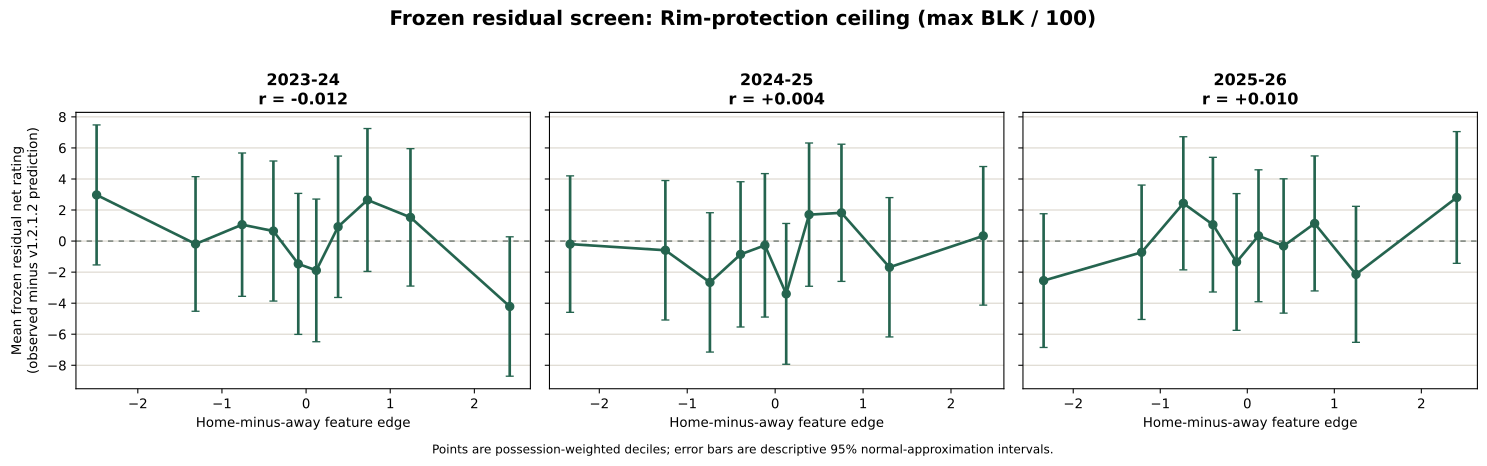
The candidate does not clear the frozen screen. Its possession-weighted residual correlations are effectively zero and change sign across seasons:
| Target season | Weighted residual correlation |
|---|---|
| 2023-24 | -0.0120 |
| 2024-25 | +0.0039 |
| 2025-26 | +0.0099 |
| Pooled | +0.0009 |
The deciles are non-monotonic, with no stable low-ceiling penalty after the
frozen NAIL-RAPM v1.2.1.2 prediction. Maximum shrunken BLK / 100 therefore
does not advance to a recursive model experiment.
Candidate Result: Creation-Spacing Alignment
Creation-spacing alignment weights each player's shrunken 3PM / 100 profile
by that player's share of the unit's prior-season usage events per 100. It is
therefore a genuine allocation feature: the same five shooting profiles can
produce different values when the usage distribution changes.
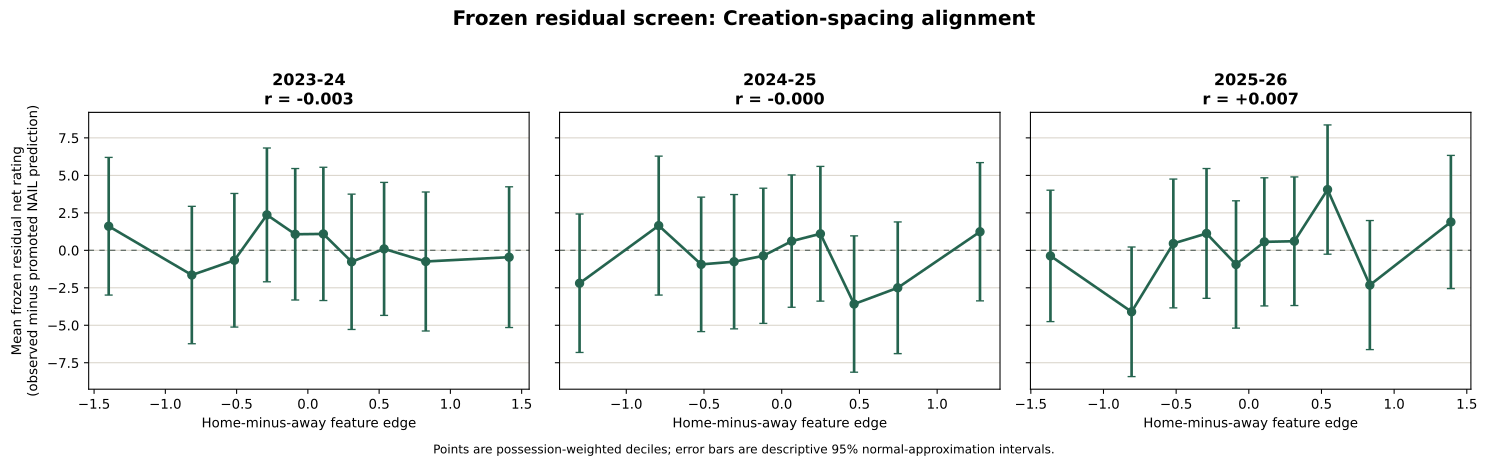
The screen does not support the candidate. Its weighted residual correlations are indistinguishable from zero, and the direction of the endpoint decile spread reverses across the three frozen seasons:
| Target season | Stints | Possessions | Weighted residual correlation | Lowest-to-highest decile spread |
|---|---|---|---|---|
| 2023-24 | 34,022 | 112,801 | -0.0028 | -2.07 |
| 2024-25 | 34,859 | 113,100 | -0.0000 | +3.43 |
| 2025-26 | 39,918 | 122,886 | +0.0070 | +2.26 |
| Pooled | 108,799 | 348,786 | +0.0017 | +1.09 |
The large endpoint movements are not a stable relationship: the decile means are noisy, non-monotonic, and their apparent direction changes by season. Creation-spacing alignment therefore does not advance to a recursive candidate fit.
Artifact:
artifacts/models/analysis/frozen_feature_screen/creation_spacing_alignment/frozen-feature-screen-creation_spacing_alignment-20260830T195938Z-24613d9e.
Candidate Result: Secondary-Creator Floor
The secondary-creator floor is the second-highest prior-season, shrunken
AST / 100 profile in a five-player unit. It tests whether the retained
top-two-assists term is specifically picking up the presence of a credible
second creator rather than the combined passing capacity of two players.
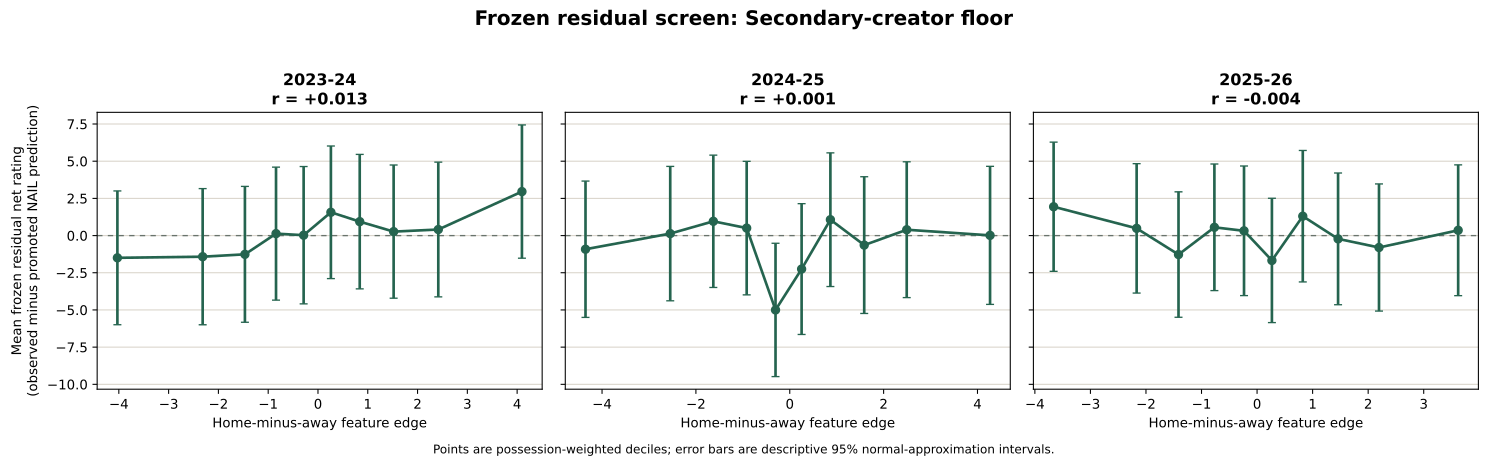
It does not clear the frozen screen. A modest positive pattern in 2023-24 vanishes in 2024-25 and reverses in 2025-26:
| Target season | Stints | Possessions | Weighted residual correlation | Lowest-to-highest decile spread |
|---|---|---|---|---|
| 2023-24 | 34,022 | 112,801 | +0.0132 | +4.45 |
| 2024-25 | 34,859 | 113,100 | +0.0005 | +0.93 |
| 2025-26 | 39,918 | 122,886 | -0.0037 | -1.58 |
| Pooled | 108,799 | 348,786 | +0.0032 | +1.23 |
The fitted positive relationship in the first season is not repeatable. The candidate therefore does not advance to a recursive model experiment.
Artifact:
artifacts/models/analysis/frozen_feature_screen/secondary_creator_floor/frozen-feature-screen-secondary_creator_floor-20260830T202300Z-2d67c5e4.
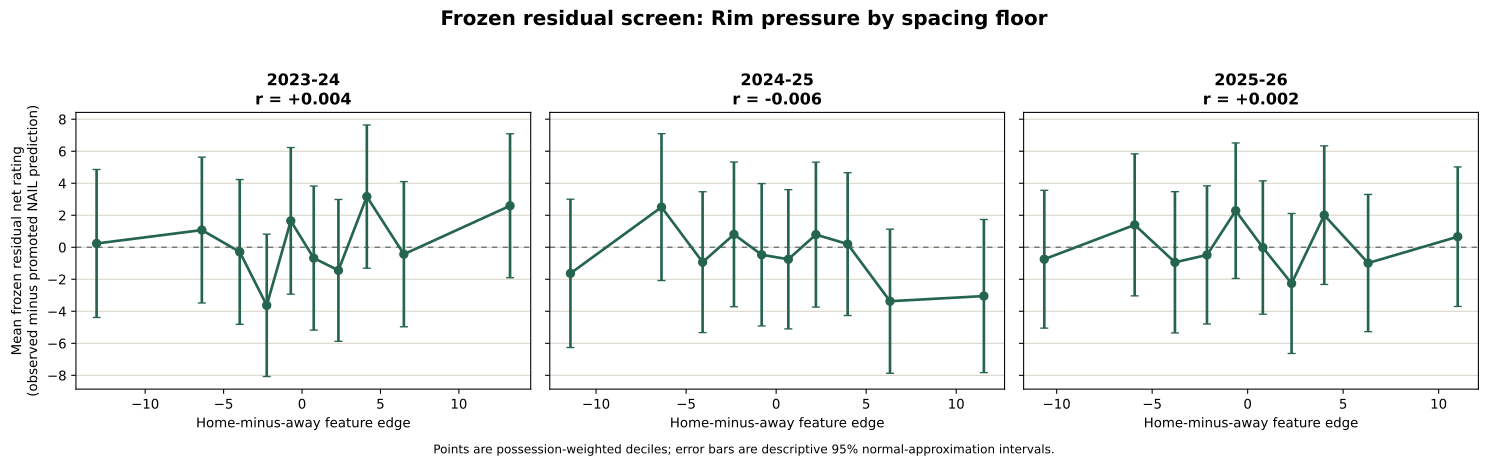
Candidate Result: Rim Pressure By Spacing Floor
This feature multiplies a unit's total shrunken unassisted rim makes per 100 by
the average shrunken 3PM / 100 profile of its two weakest spacers. It is the
continuous version of the earlier Critical Spacing hypothesis: rim pressure
should be more useful when even the unit's weakest spacers provide gravity.
The frozen screen does not support the interaction. Both the correlations and the endpoint decile direction change across seasons:
| Target season | Stints | Possessions | Weighted residual correlation | Lowest-to-highest decile spread |
|---|---|---|---|---|
| 2023-24 | 34,022 | 112,801 | +0.0038 | +2.36 |
| 2024-25 | 34,859 | 113,100 | -0.0065 | -1.42 |
| 2025-26 | 39,918 | 122,886 | +0.0016 | +1.41 |
| Pooled | 108,799 | 348,786 | -0.0001 | +0.48 |
The candidate therefore does not advance to a recursive model experiment.
Artifact:
artifacts/models/analysis/frozen_feature_screen/rim_pressure_by_spacing_floor/frozen-feature-screen-rim_pressure_by_spacing_floor-20260830T202922Z-0678e0aa.
Candidate Result: Defensive Anchor By Perimeter Pressure
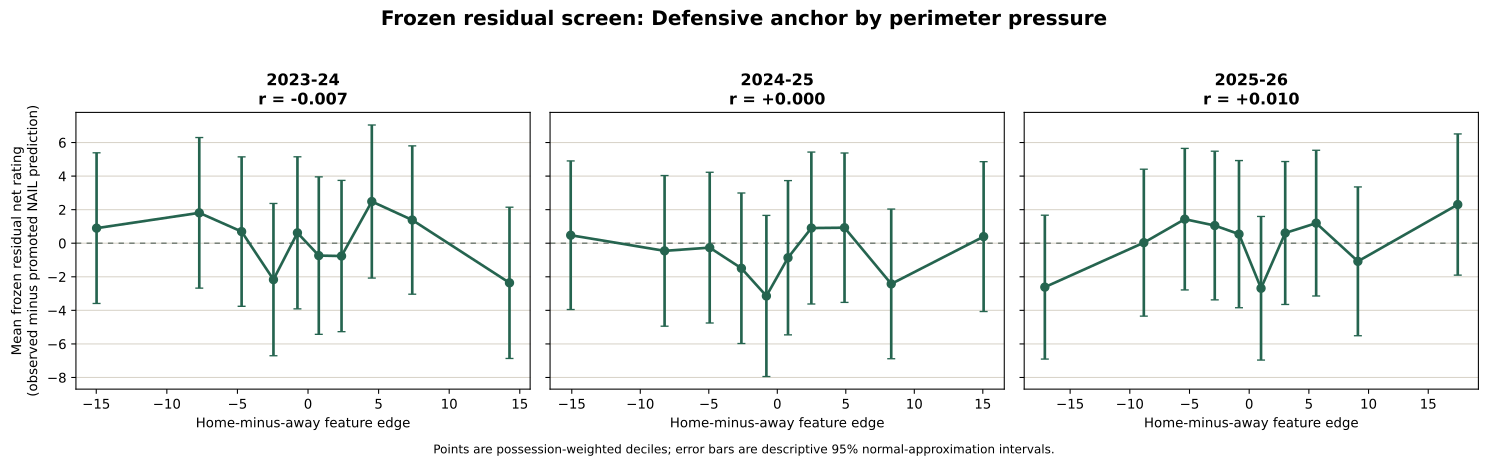
This feature multiplies the highest prior-season, shrunken block rate in a unit by the summed shrunken steal rates of the other four players. It tests whether a credible rim protector becomes more useful when surrounded by perimeter disruption, rather than asking whether blocks alone predict residual value.
The frozen screen is not stable:
| Target season | Stints | Possessions | Weighted residual correlation | Lowest-to-highest decile spread |
|---|---|---|---|---|
| 2023-24 | 34,022 | 112,801 | -0.0067 | -3.26 |
| 2024-25 | 34,859 | 113,100 | +0.0004 | -0.08 |
| 2025-26 | 39,918 | 122,886 | +0.0099 | +4.92 |
| Pooled | 108,799 | 348,786 | +0.0021 | +0.49 |
The relationship changes direction across seasons, so the candidate does not advance to a recursive model experiment.
Artifact:
artifacts/models/analysis/frozen_feature_screen/defensive_anchor_by_perimeter_pressure/frozen-feature-screen-defensive_anchor_by_perimeter_pressure-20260830T203515Z-3b3a6ee0.
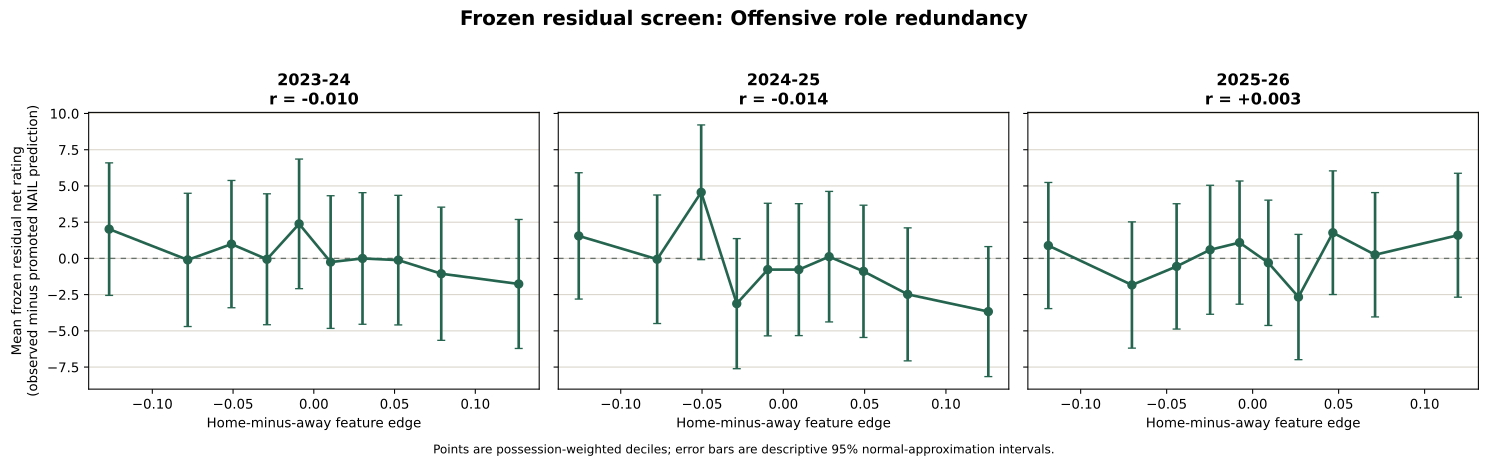
Candidate Result: Offensive Role Redundancy
For each player, this candidate forms a six-coordinate, source-season-scaled
role vector from usage events, assists, 3PA, unassisted rim makes, offensive
rebounds, and free-throw attempts per 100 possessions. Each coordinate is
divided by its source-season possession-weighted 90th percentile across all
source-season players, then each player vector is normalized to unit length.
The feature is mean pairwise cosine similarity among the five normalized role
vectors. Higher values therefore represent more similar offensive roles, with a
pre-registered expected negative residual relationship.
It has the strongest pooled screen of the newly tested candidates, but does not meet the stability gate because 2025-26 reverses direction:
| Target season | Stints | Possessions | Weighted residual correlation | Lowest-to-highest decile spread | Decile Spearman |
|---|---|---|---|---|---|
| 2023-24 | 34,022 | 112,801 | -0.0096 | -3.78 | -0.71 |
| 2024-25 | 34,859 | 113,100 | -0.0144 | -5.22 | -0.68 |
| 2025-26 | 39,918 | 122,886 | +0.0027 | +0.71 | +0.33 |
| Pooled | 108,799 | 348,786 | -0.0069 | -3.10 | -0.62 |
The candidate is therefore not advanced to a recursive fit. This is a useful negative result: a plausible role-similarity construction can look promising in pooled data while failing the required forward-season stability check.
Artifact:
artifacts/models/analysis/frozen_feature_screen/offensive_role_redundancy/frozen-feature-screen-offensive_role_redundancy-20260830T204638Z-222eb12b.
Candidate Result: Lead-Secondary Usage Gap
For each unit, this candidate subtracts the second-highest frozen, shrunken
conventional USG% profile from the highest. It was pre-registered as a
secondary-ball-handler hypothesis: a larger gap was expected to leave a
negative residual after accounting for player ratings and the incumbent
non-additive context terms.
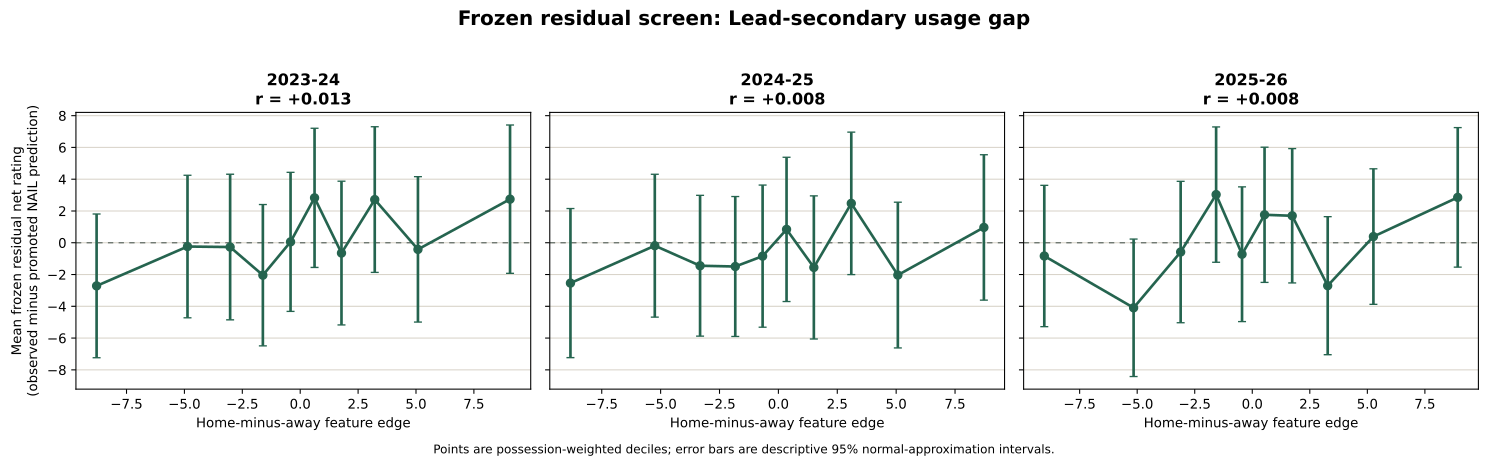
The observed relationship is stable but has the opposite sign:
| Target season | Stints | Possessions | Weighted residual correlation | Lowest-to-highest decile spread | Decile Spearman |
|---|---|---|---|---|---|
| 2023-24 | 34,022 | 112,801 | +0.0130 | +5.46 | +0.48 |
| 2024-25 | 34,859 | 113,100 | +0.0084 | +3.50 | +0.37 |
| 2025-26 | 39,918 | 122,886 | +0.0085 | +3.69 | +0.42 |
| Pooled | 108,799 | 348,786 | +0.0099 | +4.49 | +0.77 |
This clears the stability threshold for a recursive candidate fit, but it does not support the original lack-of-secondary-handler interpretation. In the conditional residual left by NAIL, a larger gap appears to describe a clearer lead-handler allocation that the incumbent model underpredicts. The full fit will determine whether the stable screen survives joint estimation with the existing context terms.
Superstars Are Not the Entire Explanation
The strongest alternative explanation is that this coordinate is merely a proxy for a unit with one elite player. To test that, the stored frozen residuals were regressed on two predictors measured from the same frozen state: the lead-secondary usage-gap edge and the home-minus-away maximum player-prior edge. Each predictor is standardized within target season and the regression is weighted by stint possessions. This is an audit only: it neither updates player ratings nor refits a context model.
| Target season | Usage-gap weight, unadjusted | Usage-gap weight, conditional | Max-prior-edge weight | Predictor correlation |
|---|---|---|---|---|
| 2023-24 | +1.33 | +1.27 | +0.43 | +0.12 |
| 2024-25 | +0.87 | +0.80 | +0.44 | +0.16 |
| 2025-26 | +0.91 | +0.70 | +0.66 | +0.31 |
| Pooled | +1.03 | +0.94 | +0.50 | +0.20 |
The candidate loses some magnitude but remains positive in every season after conditioning. It is therefore correlated with superstar imbalance without being reducible to it. The appropriate label is lead-handler allocation, not lack of a secondary ball handler.
Artifact:
artifacts/models/analysis/frozen_feature_screen/lead_secondary_usage_gap/frozen-feature-screen-lead_secondary_usage_gap-20260830T210743Z-2be1ccce.
Conditional audit artifact:
artifacts/models/analysis/lead_secondary_usage_gap_conditioning/lead-secondary-usage-gap-conditioning-20260830T211716Z-6ba81f6c.
Production Controls
The two retained production non-additive terms validate the screen's leave-one-term-out control path. For each one, the frozen prediction retains every other component but omits that term's own contribution. Both produce a small but directionally stable positive residual relationship across all three target seasons:
| Feature | 2023-24 | 2024-25 | 2025-26 | Pooled |
|---|---|---|---|---|
| Usage concentration | +0.0166 | +0.0128 | +0.0142 | +0.0146 |
| Top-two assists / 100 | +0.0057 | +0.0096 | +0.0066 | +0.0073 |
The pooled usage-concentration deciles move from -1.73 to +2.84 residual
net-rating points from the lowest to highest feature edge. Top-two assists move
from -1.34 to +1.84. Middle deciles remain noisy because stint outcomes are
noisy; these controls validate that the screen recovers a withheld production
term, not that it establishes a causal effect.
Candidate Result: Prior-Season Teammate Continuity
This candidate measures historical relationships rather than individual player profiles. For target season \(t\), let \(P_{ij,t-1}\) be the regular-season possessions that players \(i\) and \(j\) shared on the same unit during the immediately preceding season. For a five-player unit \(U\), define
All ten pairs receive equal weight. Pairs without prior shared possessions contribute zero, so one new player reduces but does not erase the continuity of an established four-player core. The screen uses no decay rate, minimum exposure threshold, target-season shared possessions, or target-season player profile information.
Unlike the earlier screens on this page, this run uses the promoted NAIL-RAPM v1.2.1.3 residualized-lambda state as its frozen baseline. The candidate has a small positive residual correlation in every season:
| Target season | Stints | Possessions | Weighted residual correlation | Lowest-to-highest decile spread |
|---|---|---|---|---|
| 2023-24 | 34,022 | 112,801 | +0.0093 | +3.90 |
| 2024-25 | 34,859 | 113,100 | +0.0081 | +1.60 |
| 2025-26 | 39,918 | 122,886 | +0.0106 | +3.21 |
| Pooled | 108,799 | 348,786 | +0.0093 | +2.34 |
The decile relationship is not perfectly monotonic, but its direction is
consistent. Spearman correlations across the ten residual-bin means are
+0.66, +0.78, and +0.54 by season, and +0.83 pooled. Approximately
5-7% of evaluated side lineups have zero prior continuity, so the result is not
being inferred from a tiny all-new-lineup cohort.
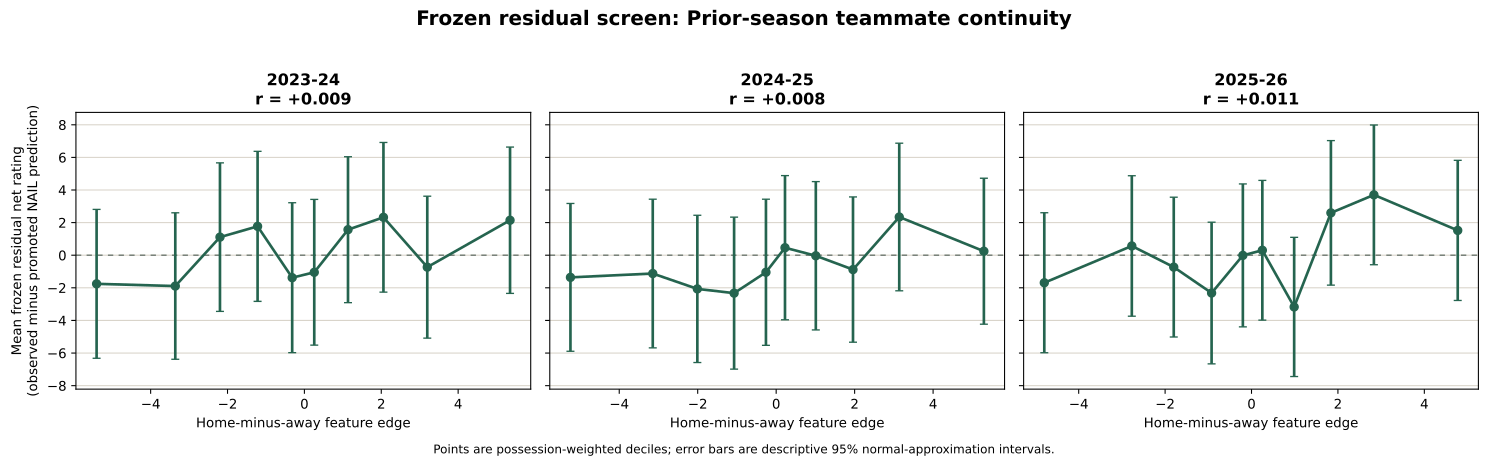
Screen decision: advance to a controlled recursive candidate fit. The signal was comparable in magnitude to the retained non-additive positive controls and stable across the three frozen seasons. The subsequent full fit found a highly stable positive coefficient but no material incremental frozen lift, so the feature was not promoted. See the complete candidate result.
Artifacts:
- Screen:
artifacts/models/analysis/frozen_feature_screen/prior_teammate_continuity/frozen-feature-screen-prior_teammate_continuity-20260830T042640Z-911b48a2 - Pair exposure:
prior_pair_exposures.parquetinside the screen artifact